
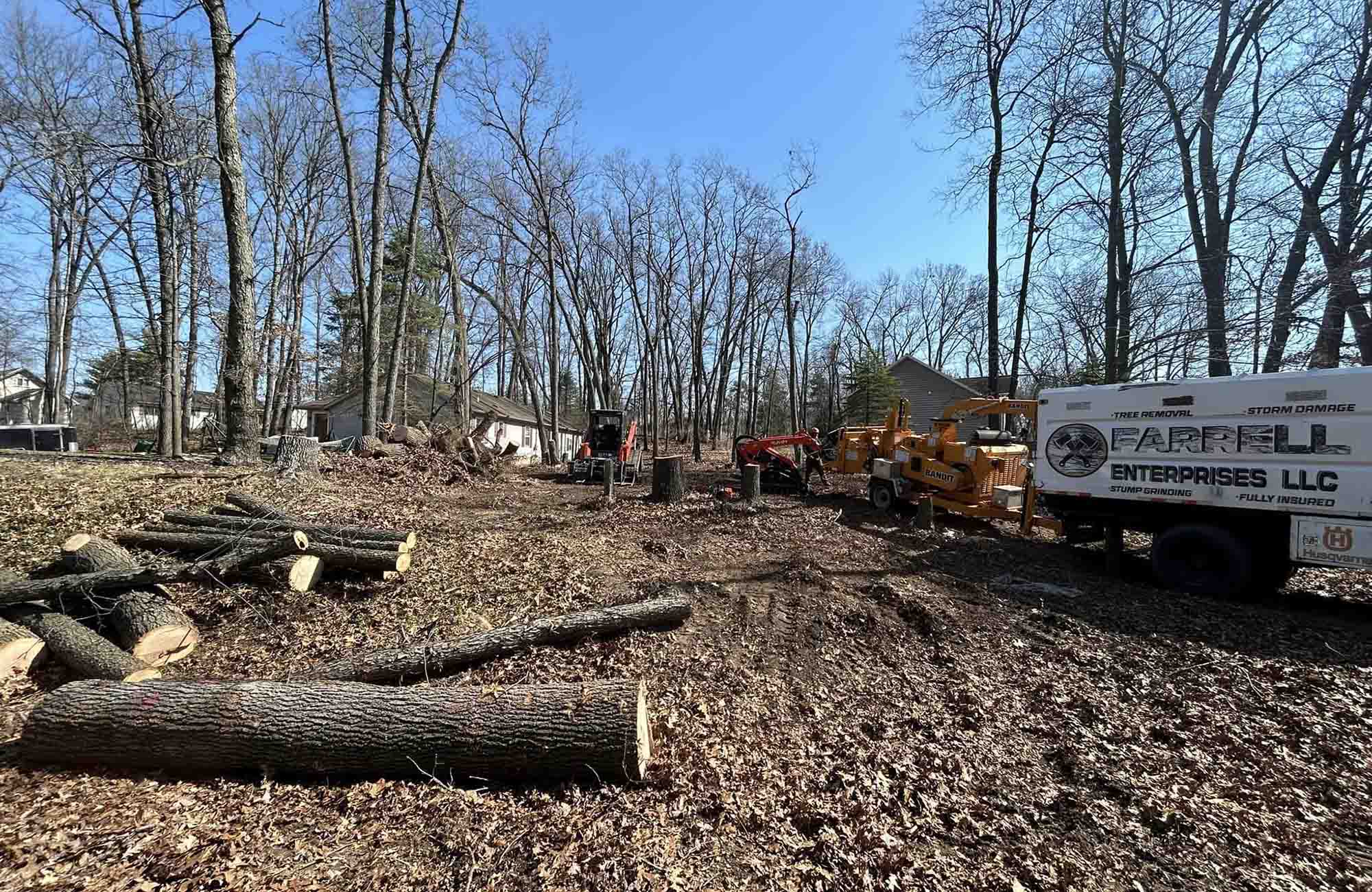
Professional Land Clearing Services in South Central Michigan
Preparing land for construction, development, agriculture, improved access, or general property use often begins with professional land clearing. Trees, brush, stumps, dense vegetation, and other obstacles can make it difficult to move equipment onto a site, establish a building area, install a driveway, or simply make better use of your property.
Farrell Enterprises provides professional land clearing services for residential, commercial, agricultural, rural, and undeveloped properties throughout South Central Michigan. We work with homeowners, builders, businesses, farmers, property managers, and landowners on projects ranging from smaller residential lots to larger wooded and overgrown properties.
Every property is different. Some projects require complete removal of trees and stumps so construction can begin. Others may only need selective clearing, brush removal, access improvement, or forestry mulching. Our team evaluates the property, terrain, vegetation, access, nearby structures, and your plans for the land before recommending an approach.
Whether you are preparing a site for a new home, clearing space for a garage, opening access through wooded acreage, or reclaiming an overgrown lot, Farrell Enterprises can help prepare the property for its next use.
Land Clearing for New Construction
One of the most common reasons property owners need land clearing is to prepare a site for construction.
Before a home, garage, pole barn, commercial building, driveway, septic system, or other improvement can be installed, the construction area may need to be cleared of trees, brush, stumps, and other obstacles.
Land clearing for construction may include:
- Removing trees within the building area
- Clearing brush and dense vegetation
- Removing or grinding stumps
- Opening access for construction equipment
- Clearing proposed driveways or private roads
- Removing vegetation around utility routes
- Preparing space for garages and outbuildings
- Clearing areas for septic or drainage improvements
- Removing trees that interfere with site layout
The amount of clearing required depends on the project. A new home site may require a relatively open building area with trees and stumps removed, while a driveway or access route may only require a narrower corridor.
Planning the clearing work around the construction layout can help avoid removing trees unnecessarily and reduce duplicate work later in the project.
Residential Land Clearing
Homeowners may need land clearing for many different reasons beyond new construction.
Residential land clearing can help create space for:
- Home additions
- Garages and sheds
- New driveways
- Expanded yards
- Patios and outdoor living areas
- Gardens and landscaping
- Fencing
- Recreational areas
- Improved access to wooded portions of the property
Overgrown residential lots can also become difficult to maintain when brush, saplings, vines, and unwanted trees are allowed to take over.
Selective clearing can reclaim these areas while preserving mature trees that contribute shade, privacy, or visual appeal.
Our goal is not necessarily to remove everything. In many cases, the best result comes from removing unwanted or hazardous vegetation while retaining desirable trees and natural features.
Commercial Land Clearing
Commercial land clearing often requires a larger-scale approach and careful coordination around access, equipment, buildings, customers, employees, and future construction plans.
Farrell Enterprises provides land clearing for commercial properties preparing for:
- New buildings
- Facility additions
- Parking areas
- Access roads
- Storage areas
- Utility installation
- Landscaping improvements
- Property expansion
- Undeveloped commercial sites
Commercial clearing may involve removing trees and vegetation from a defined development area while preserving other portions of the property.
Good planning is especially important on commercial sites because clearing work may need to fit into a larger construction schedule or occur around active operations.
Land Clearing for Farms and Agricultural Properties
Farms and rural properties often require land clearing for different reasons than residential or commercial sites.
Agricultural land clearing may be used to:
- Expand fields or pastures
- Clear around barns and outbuildings
- Improve equipment access
- Open farm lanes
- Clear fence lines
- Remove unwanted trees at field edges
- Reclaim overgrown portions of the property
- Prepare sites for agricultural structures
Trees and brush can gradually encroach on open land, reducing usable acreage and making fence, field, and equipment maintenance more difficult.
Professional clearing can help reclaim these areas and improve the overall usability of the property.
Clearing Wooded and Overgrown Property
Some land does not need to be prepared for immediate construction. The goal may simply be to make it more accessible, manageable, and useful.
Wooded or overgrown land clearing can help with:
- Opening trails
- Creating equipment access
- Reclaiming old fields
- Improving hunting property
- Clearing around ponds
- Opening recreational areas
- Managing brush around cabins
- Clearing property boundaries
- Preparing future building areas
- Improving visibility and access throughout acreage
The right approach depends on the density and size of the vegetation.
Properties dominated by brush, vines, and smaller trees may be good candidates for forestry mulching, while areas containing larger trees and stumps may require more traditional clearing methods.
Traditional Land Clearing vs. Forestry Mulching
Traditional land clearing and forestry mulching can both improve overgrown property, but they serve different purposes.
Traditional land clearing is generally the better option when trees, stumps, and roots must be removed so the land can be excavated, graded, or prepared for construction.
It may be appropriate when:
- A building foundation will be installed
- A driveway or road is being constructed
- Stumps must be completely removed
- Large trees need to be taken out
- The ground will undergo significant site preparation
Forestry mulching is often better suited for vegetation management when complete excavation is unnecessary.
A forestry mulcher can process brush, saplings, vines, and smaller woody vegetation directly on the property. This can be useful for reclaiming overgrown acreage, opening trails, clearing fence lines, and improving access without removing every root system.
Many properties benefit from both methods. A future building area may require traditional clearing, while surrounding acreage can be selectively mulched.
Tree Removal as Part of Land Clearing
Larger trees often require a different approach from brush and smaller vegetation.
When mature trees are located within a proposed building area, driveway, or development site, professional tree removal services may be incorporated into the land clearing project.
Tree removal planning considers:
- Tree size
- Direction of lean
- Surrounding structures
- Nearby trees
- Available drop zones
- Equipment access
- Terrain
- Future use of the area
Some trees can be removed through controlled felling, while others may require sectional removal, rigging, aerial equipment, or crane assistance.
Coordinating tree removal with the overall land clearing plan can help make the project more efficient.
Stump Removal and Stump Grinding
Removing the tree is only part of preparing land for future use.
Stumps may interfere with construction, mowing, driveways, landscaping, or equipment access. Depending on the planned use of the property, they may need to be ground or removed.
Stump grinding reduces the visible stump below ground level and may be appropriate for lawn areas, landscaping, or locations where full root excavation is unnecessary.
Construction areas may require a different approach if the entire stump and major root system must be removed before excavation or grading.
The intended use of the property helps determine which option makes the most sense.
Clearing for Driveways and Access Roads
Access is often one of the first challenges on larger rural or wooded properties.
A new driveway, private road, construction access route, or equipment lane may require trees, brush, and stumps to be removed before other work can begin.
Clearing an access route may involve:
- Tree removal
- Brush clearing
- Overhead clearance
- Stump removal or grinding
- Forestry mulching along the edges
- Improving visibility
- Opening space for construction equipment
Establishing access early can make later phases of construction or land management easier.
Selective Clearing Instead of Complete Removal
Not every property should be completely cleared.
Selective land clearing allows property owners to remove specific trees, brush, and obstacles while preserving healthy mature trees and other desirable vegetation.
This approach may be useful for:
- Residential building sites
- Lakefront properties
- Recreational acreage
- Wooded homesites
- Hunting property
- Rural residential lots
- Properties where privacy is important
Selective clearing can help preserve the natural character of the land while still creating space for buildings, roads, trails, and outdoor areas.
Before beginning work, it is helpful to identify trees and areas you want to preserve so the clearing plan can be developed around them.
Lakefront and Sloped Property Clearing
Lakefront, sloped, and erosion-prone properties require additional consideration.
Trees and vegetation can play an important role in holding soil in place and slowing runoff. Removing too much vegetation at once may expose soil and increase erosion.
Clearing plans for these properties should consider:
- Slope
- Existing vegetation
- Drainage
- Soil conditions
- Shoreline location
- Retaining walls
- Equipment access
- Areas that should remain undisturbed
In many cases, selective clearing or forestry mulching may be more appropriate than completely removing vegetation across a large area.
What Affects the Cost of Land Clearing?
There is no single price per acre that applies to every land clearing project.
The cost depends on the condition of the property and the amount of work required.
Important factors include:
- Total acreage
- Number of trees
- Tree size
- Density of brush
- Number and size of stumps
- Terrain and slope
- Ground conditions
- Equipment access
- Distance from buildings or utilities
- Amount of debris
- Whether material must be hauled away
- Desired condition of the finished site
- Whether traditional clearing or forestry mulching is used
A relatively open acre containing light brush may require far less work than an acre containing mature trees, large stumps, dense vegetation, and difficult terrain.
An on-site evaluation provides a much more accurate picture of project scope than acreage alone.
Our Land Clearing Process
Property Evaluation
The first step is understanding the property and what you want to accomplish.
We evaluate vegetation, tree size, terrain, access, nearby structures, property boundaries, and other factors that may influence the work.
We also discuss the intended use of the site so we know how thoroughly the area needs to be cleared.
Planning the Clearing Approach
Once the site has been evaluated, we determine which methods are appropriate.
The project may involve:
- Traditional clearing
- Tree removal
- Stump grinding
- Forestry mulching
- Selective vegetation removal
- Debris processing and cleanup
Different sections of the same property may require different methods.
Clearing Trees and Vegetation
The clearing work is completed according to the site plan.
Large trees may be removed separately, while brush and smaller vegetation may be processed using other equipment.
Throughout the work, attention is given to structures, remaining trees, access routes, and areas that are intended to stay undisturbed.
Debris Management and Cleanup
Land clearing can produce logs, branches, brush, stumps, chips, and other organic material.
How this material is handled depends on the project.
Possible options may include:
- Chipping brush
- Mulching vegetation in place
- Cutting logs into manageable sections
- Hauling selected debris away
- Leaving certain wood for the property owner
Cleanup expectations should be discussed before work begins so everyone understands the intended condition of the site.
Preparing for a Land Clearing Project
Property owners can help make the process smoother by identifying important features before the project begins.
Consider locating or marking:
- Property boundaries
- Septic areas
- Wells
- Underground utilities
- Buildings and planned structures
- Trees that should remain
- Driveways and access routes
- Sensitive landscaping
- Wet or soft areas
For construction projects, having a site plan available can also help identify exactly which areas need to be cleared.
Permits or approvals may be required for certain projects depending on location, property type, wetlands, shoreline conditions, road access, or other site-specific factors. Property owners should verify applicable requirements before major clearing begins.
Land Clearing in Jackson, Hillsdale, and South Central Michigan
Farrell Enterprises provides professional land clearing throughout South Central Michigan, including Jackson, Hillsdale, Brooklyn, Napoleon, Jonesville, Hanover, Somerset, Onsted, Spring Arbor, Jerome, North Adams, Addison, Concord, and surrounding communities.
We work with a wide variety of properties, including:
- Residential lots
- Commercial sites
- Farms
- Wooded acreage
- Lakefront property
- Recreational land
- Vacant lots
- Construction sites
- Rural property
Visit our Locations page to learn more about the communities we serve.
Why Choose Farrell Enterprises for Land Clearing?
Land clearing is often only one part of a larger property project.
Farrell Enterprises provides a range of related services, including tree removal, stump grinding, forestry mulching, logging, preventative tree maintenance, and emergency tree services.
This allows us to look at the entire property and recommend an approach based on what actually needs to be accomplished.
A project may involve removing mature trees from a future home site, grinding selected stumps, mulching brush around the perimeter, and opening an access route for construction equipment. Handling these services as part of one coordinated plan can make the overall project more efficient.
Our goal is to provide practical land clearing solutions that prepare your property for its next use while minimizing unnecessary disturbance to areas that do not need to be cleared.
Request a Free Land Clearing Estimate
Whether you are preparing a lot for new construction, reclaiming overgrown acreage, clearing space for a driveway or outbuilding, or improving access through wooded land, Farrell Enterprises can help.
Contact Farrell Enterprises today to request a free estimate for professional land clearing in Jackson, Hillsdale, and surrounding South Central Michigan communities.
Tell us about your property and what you plan to do with the land, and our team can evaluate the site and recommend an appropriate clearing approach.